
What Gets Harder This Year and Why Action Can't Wait
Those of you who reported for packaging EPR in 2025, you don't need a primer, you remember the mad scramble. Packaging data scattered across systems and formats, missing information across SKUs, suppliers responding late or not at all, spreadsheets patched together with estimates under deadline pressure, and outside help brought in simply to get a submission across the line.
If your 2025 reporting depended on assumptions, blended averages, or extraordinary internal effort, that approach will not scale in 2026.
This article is written for brands (producers) compliance, sustainability, and operations leaders who need clarity on:
- Why 2026 is a step-change year for packaging EPR compliance
- Which 2026 packaging EPR reporting deadlines in the USA actually matter
- Why a May deadline means work must start now
- What steps to take and who can help
1. Why 2026 Is a Step-Change Year for EPR Compliance
2025 functioned as a ramp-up year. It was the first year of packaging EPR in the USA, with regulators observing how data flowed, PROs testing systems, and many brands relying on temporary workarounds to get reports submitted.
What scraped by in 2025 will fail in 2026
Brands that barely made it through last year are now facing a far less forgiving reporting cycle. More states EPR programs are coming online, data expectations are increasing, tolerance for estimates is disappearing, and enforcement expectations are rising.
What has materially changed in 2026:
- California, Colorado, and Oregon data reports are due at same time - the accuracy and validity of 2025 data drastically affects how much brands will be paying
- Four additional state EPR programs (Maine, Minnesota, Washington, and Maryland) are rolling out - with various obligations from registration to first supply reports due.
- Audits and follow-up questions are becoming standard, not exceptional. Get ready for enforcement actions to be wielded, as states rely on producer EPR fees to fund these expensive programs.
2. 2026 Packaging EPR Reporting Deadlines in the USA: What Actually Matters
Key takeaway:
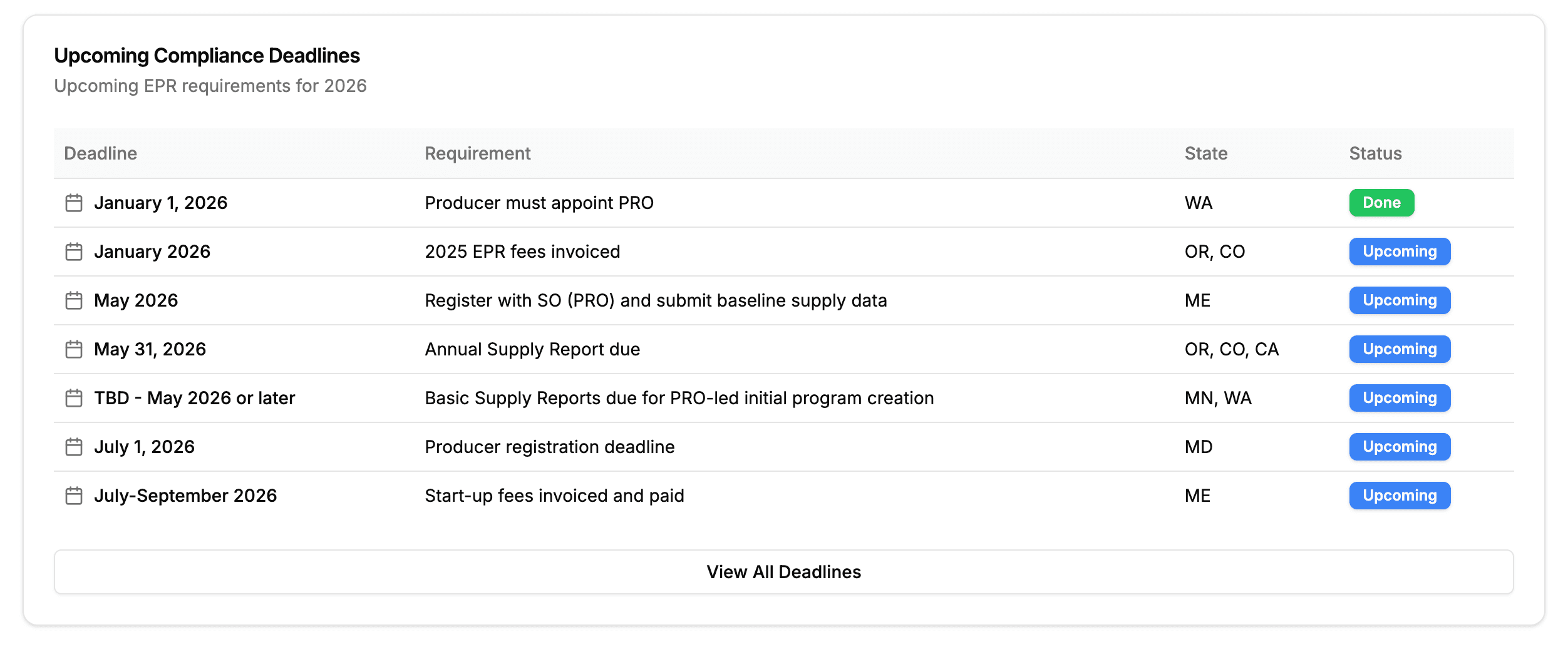
Instead of a report due every few months the majority of 2026 reporting data work must be done in next 3-4 months to meet May 2026 deadlines.
| Deadline | Requirement | State |
|---|---|---|
| January 1, 2026 | Producer must appoint PRO | WA |
| January 2026 | 2025 EPR fees invoiced | OR, CO |
| May 2026 | Register with SO (PRO) and submit baseline supply data | ME |
| May 31, 2026 | Annual Supply Report due | OR, CO, CA |
| TBD – May 2026 or later | Basic Supply Reports due for PRO-led initial program creation | MN, WA |
| July 1, 2026 | Producer registration deadline | MD |
| July–September 2026 | Start-up fees invoiced and paid | ME |
3. A May Deadline Means Starting Now
May? That's months away, we have time.
For most producers, this assumption proves costly the moment they confront the reality of their packaging data.
Packaging data lives across spreadsheets, supplier PDFs, emails, PLMs, ERPs, and institutional knowledge. In practice, it is fragmented and inconsistent, honestly it's often utter chaos. For brands not using a software system like Unpac to ingest their data and structure their data, it often takes weeks—sometimes months—just to understand what data exists, what's missing, and where to go from here.
Before a single report can be submitted, producers must:
- Confirm reporting scope across SKUs and states (what was sold, and where)
- Establish a clear BOM for each SKU, with granular, component-level packaging data
- Chase suppliers to close gaps in missing or outdated specifications
- Translate 2025 data into multiple state-specific reporting templates, each with different material categories, exclusions, and fee logic
- Validate the data internally and secure sign-off
This is not a "month or two before" job (especially for 4 separate states to report for). When brands start late, they uncover data gaps at every step and are forced to rely on estimates. leads to manual SKU-level data work, internal disruption, and elevated audit and fee exposure as estimates diverge from reality.
This is how EPR reporting quietly becomes a six-figure annual problem and major headache not just for packaging teams, but across finance, operations, and compliance.
4. What Steps to Action Now and Who Can Help
The brands that are succeeding in 2026 are not working harder, they are working from a single, structured source of truth.
This is exactly why we built Unpac: to take chaotic, fragmented packaging data and normalize it into one consistent structure that can be reused across states, reporting cycles, and regulatory templates.
Without a software-led system like Unpac, brands typically spend weeks just orienting themselves before they can even begin validating data, filling gaps, and translating it into multiple state-specific formats.
At this stage, producers should focus on a small set of critical questions:
- Do we actually have complete, defensible 2025 packaging data?
- Where are the gaps? and how long will it take to close them?
- How can get our data ready to report in time?
- Who owns packaging data going forward? Can our current process scale as more states come online?
Businesses are engaging Unpac and our trusted partners because fixing foundational data issues is an investment in control that reduces costs, time, and risk.
What changes when EPR data is under control
- Operational stability: Reporting becomes routine, not disruptive. Clear ownership replaces last-minute scrambling.
- Financial predictability: Fee exposure can be accurately modeled in advance. Packaging decisions reflect real EPR cost signals.
- Supplier leverage: Data requirements become contractual, not ad hoc. Less dependence on goodwill during reporting season.
- External confidence: Retailers and partners see lower compliance risk. ESG disclosures are backed by auditable data.
Final Thought
In 2025, many brands focused on one thing: getting a report submitted. For most, that meant a recurring fire drill: manual work, estimates, and last-minute pressure.
2026 determines whether that pain becomes permanent OR is replaced by a repeatable operating capability.
The deadlines are fixed. The scrutiny is rising.
The only lever you control is how early you act.
If you have questions about your 2026 obligations or want to understand what readiness really looks like, reach out to the team at team@getunpac.com.
For additional guidance, visit the official EPR program resources below:
Circular Action Alliance (CAA)
Stay tuned for more articles breaking down state-specific requirements, packaging data management strategies, and how leading brands are operationalizing EPR at scale.